
What Does mM Mean in Chemistry?
mM means millimolar: 1 mM = 0.001 M = 1 millimole per liter. Learn how to read mM in lab protocols, with examples and conversions to M, µM and nM.
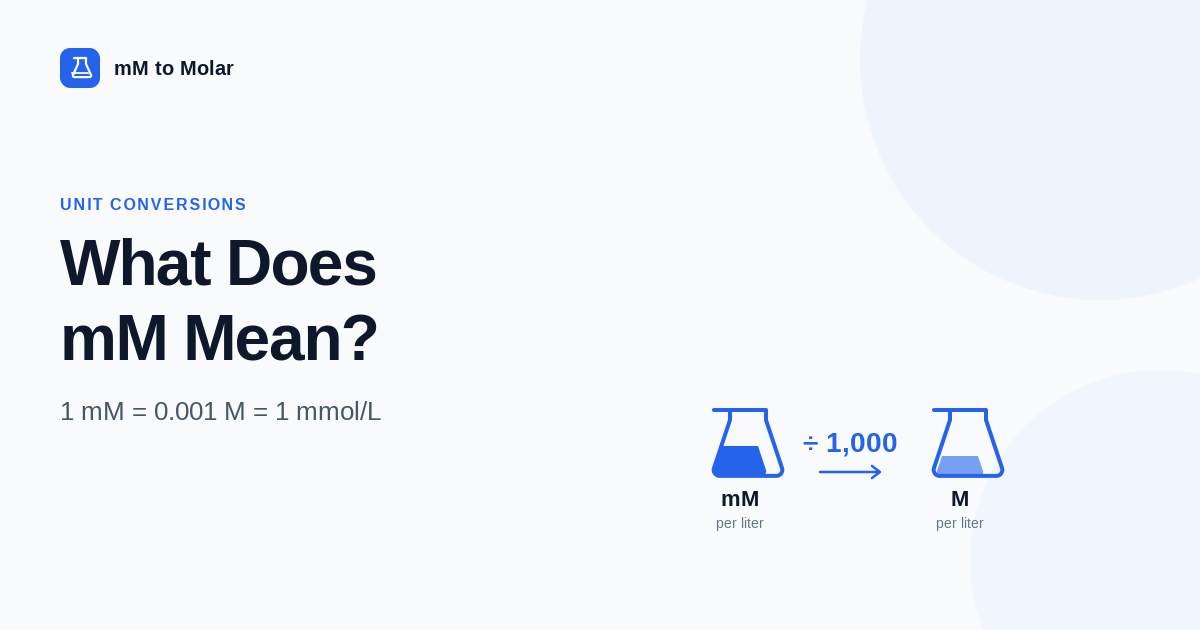
mM means millimolar. It is a unit of concentration, and 1 mM means 1 millimole of a substance dissolved in 1 liter of solution. In short: 1 mM = 0.001 M = 1 mmol/L.
You will see mM everywhere in chemistry and biology: on reagent bottles, in lab protocols, in drug doses, and in blood test results. It is the standard unit for solutions that are too dilute to write sensibly in molar, but too concentrated to write in micromolar.
If you just need a number, use the mM to molar converter and skip the reading.
Breaking down the symbol mM
The symbol has two parts, and each part means something.
The small "m" is the metric prefix "milli", which means one-thousandth, or 0.001. The capital "M" is the symbol for molar, which means moles per liter.
So mM is literally milli-molar: one-thousandth of a molar. That is why 1 mM = 0.001 M, and 1,000 mM = 1 M.
The capital letter matters. Lowercase "mm" means millimeter, a length. "mM" with a capital M means millimolar, a concentration. A protocol that says "5 mm" when it means "5 mM" is a typo, and it changes the meaning completely.
What mM actually measures
mM measures how many molecules are in a volume of liquid, not how heavy the liquid is. A 10 mM glucose solution and a 10 mM salt solution contain the same number of molecules per liter, but they weigh different amounts, because a glucose molecule is heavier than a salt molecule.
That is the key idea: mM counts molecules, while mg/mL counts mass. To go from one to the other, you need the molecular weight. For glucose, with a molecular weight of 180.16 g/mol, 1 mg/mL is 5.55 mM. For sodium chloride, with a molecular weight of 58.44 g/mol, 1 mg/mL is 17.11 mM. The same mass gives a different mM value for every substance.
A concentration in mM tells you three things at once: the substance, the amount in millimoles, and the volume in liters. "10 mM glucose" means 10 millimoles of glucose in every liter of solution. It does not tell you the mass, and it does not tell you the total amount unless you also know the volume. In 100 mL of a 10 mM solution, there is 1 millimole. In 1 liter, there are 10 millimoles.
How to read mM in a lab protocol
When a protocol says "add buffer to a final concentration of 50 mM", it means the finished solution, after everything is mixed, must contain 50 millimoles of that buffer per liter.
When it says "make a 1 M stock and dilute to 10 mM", it means make the strong solution first, then dilute it 100 times, because 1 M is 1,000 mM and 1,000 divided by 10 is 100.
When it says "the final volume is 100 mL at 10 mM", work out the amount first: 10 mmol/L x 0.1 L = 1 mmol. Then convert that to mass if you are weighing a solid, or to volume if you are pipetting from a stock.
A worked dilution: you need 100 mL of a 10 mM solution, and you have a 1 M stock. The dilution factor is 1,000 mM divided by 10 mM, which is 100. So take 1 mL of the 1 M stock and add water up to 100 mL. Check it: 1 mL of 1 M contains 1 mmol, and 1 mmol in 100 mL is 10 mmol/L, which is 10 mM.
mM, M, µM and nM: the full scale
These units are all the same kind of measurement, just at different sizes. Each step is a factor of 1,000.
| Unit | Symbol | In molar (M) | In millimolar (mM) |
|---|---|---|---|
| Molar | M | 1 M | 1,000 mM |
| Millimolar | mM | 0.001 M | 1 mM |
| Micromolar | µM | 0.000001 M | 0.001 mM |
| Nanomolar | nM | 0.000000001 M | 0.000001 mM |
So 1 M = 1,000 mM, 1 mM = 1,000 µM, and 1 µM = 1,000 nM. To go from mM to M, divide by 1,000. To go from M to mM, multiply by 1,000. To go from mM to µM, multiply by 1,000.
A quick check: 0.025 M is 25 mM, because 0.025 x 1,000 = 25. And 250 µM is 0.25 mM, because 250 divided by 1,000 = 0.25.
Scientists pick the unit that keeps the number between 1 and 1,000 where possible. That is why blood glucose is written as 5 mM instead of 0.005 M, and why a hormone is written as 100 nM instead of 0.0001 mM.
mM in real life: blood, buffers and cells
mM is not just a textbook unit. These are real values you will meet:
Fasting blood glucose, 3.9 to 5.6 mM. In countries that report blood sugar in millimolar, a healthy fasting value is 3.9 to 5.6 mM, which is the same as 70 to 100 mg/dL. The two numbers describe the same blood sample in different units.
Normal saline, 154 mM sodium chloride. A standard IV drip is 0.9% salt water, which is 9 grams of sodium chloride per liter. That works out to about 154 mM, close to the salt concentration of human blood.
Inside a cell, 140 to 150 mM potassium. Potassium inside a living cell sits at about 140 to 150 mM, while outside the cell, in blood serum, it is only about 4 mM. That difference is what lets nerves and muscles work.
Lab buffers, 5 to 150 mM. Common buffers such as Tris-HCl, HEPES and phosphate-buffered saline are made with their components in the 5 to 150 mM range. For example, standard phosphate-buffered saline contains about 137 mM sodium chloride, 2.7 mM potassium chloride and 10 mM phosphate.
Cell energy, 1 to 10 mM ATP. Adenosine triphosphate, the molecule cells use for energy, is typically kept at 1 to 10 mM inside a resting cell.
When a value is far below 1 mM, scientists switch down a step. Resting calcium inside a cell is about 100 nM, which is 0.0001 mM. Writing it as 0.0001 mM would be clumsy, so nM is the right unit there.
mM vs mmol: the mistake to avoid
mM and mmol look almost the same, but they are not the same thing.
mM, millimolar, is a concentration: millimoles per liter. mmol, millimole, is an amount: one-thousandth of a mole, with no volume attached.
A bottle labelled "10 mM" tells you the concentration. A protocol that says "add 10 mmol" tells you the amount to add, and you still need the volume to know the final concentration. For example, 500 mL of a 2 mM solution contains 1 mmol of solute, because 2 mmol/L x 0.5 L = 1 mmol. The same 1 mmol in 100 mL would be a 10 mM solution instead.
This is covered in detail in millimolar vs millimole.
Common mistakes
Reading mM as millimole. mM is millimoles per liter. If you forget the "per liter", you will get the amount wrong whenever the volume is not 1 liter.
Writing mm for mM. Lowercase "mm" is millimeter. Always write millimolar as "mM", with a small m and a capital M.
Confusing mM with mg/mL. A solution can be 10 mg/mL and 55.51 mM at the same time, like 10 mg/mL of glucose. They measure different things, mass and molecule count, so one does not replace the other. This is covered in the mg/mL to millimolar guide.
Forgetting the factor of 1,000. 1 M is 1,000 mM, not 100 mM and not 10 mM. A 0.1 M solution is 100 mM, and a 0.01 M solution is 10 mM. One slipped zero changes the answer by ten times.
Using mM for a solid. mM only describes a solution. A powder on its own has a mass, in grams or milligrams, not a concentration. It only gets an mM value once it is dissolved in a known volume.
Frequently asked questions
What does mM stand for?
mM stands for millimolar. It means a concentration of 1 millimole of solute per liter of solution, which is 0.001 moles per liter.
What is 1 mM equal to?
1 mM is equal to 0.001 M, 1 mmol/L, 1,000 µM and 1,000,000 nM.
Is mM the same as mmol?
No. mM is a concentration, millimoles per liter. mmol is an amount, one-thousandth of a mole. A 2 mM solution contains 2 mmol in every liter, but only 1 mmol in 500 mL.
What does 10 mM mean?
10 mM means 10 millimoles of a substance in every liter of solution. That is 0.01 M, or 10,000 µM. In 100 mL of a 10 mM solution, there is 1 millimole.
Is 5 mM a high concentration?
It depends on the substance. For blood glucose, 5 mM is normal. For a buffer, 5 mM is on the low side. For a drug or a hormone, 5 mM would be very high. Always judge an mM value against the normal range for that substance.
How do you convert mM to M?
Divide by 1,000. For example, 25 mM divided by 1,000 is 0.025 M. To go the other way, multiply by 1,000: 0.025 M x 1,000 is 25 mM.
Need to convert a value now? Use the mM to molar converter for mM, M, µM and nM, or learn the full definition on the what is millimolar page.
Written by
Shaheer Akram
Specialist at mM to Molar, developing accurate, peer-reviewed calculation tools and reference guides for chemists, biologists, and laboratory researchers.