
mg/mL to Millimolar: How to Convert mg/mL to mM (With Examples)
Convert mg/mL to millimolar with the formula mM = mg/mL x 1,000 / molecular weight. Worked examples for glucose and sodium chloride, plus a chart.
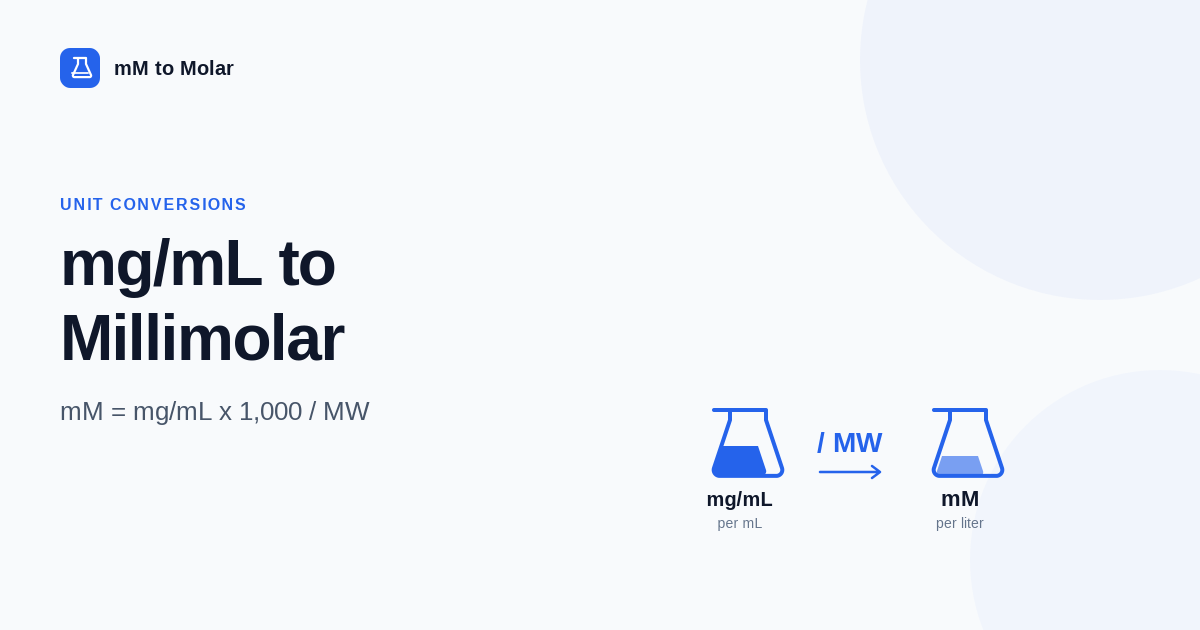
To convert mg/mL to millimolar, multiply by 1,000 and divide by the molecular weight. The formula is mM = mg/mL x 1,000 / molecular weight (g/mol). So 1 mg/mL of glucose, with a molecular weight of 180.16 g/mol, is 5.55 mM. To go the other way, multiply by the molecular weight and divide by 1,000. That is the whole conversion, and the rest of this guide shows how it works and where people slip up.
If you just need a number, use the mg/mL to millimolar calculator and skip the reading.
The formula for mg/mL to mM
Milligrams per milliliter (mg/mL) is a mass concentration: how many milligrams of a substance are in one milliliter of solution. Millimolar (mM) is a molar concentration: how many millimoles are in one liter. You cannot convert one to the other with a fixed number, because a milligram of glucose and a milligram of salt contain different numbers of molecules. The molecular weight bridges the two units:
mM = mg/mL x 1,000 / molecular weight (g/mol)
mg/mL = mM x molecular weight (g/mol) / 1,000
The 1,000 in the formula comes from two unit changes at once: milliliters to liters, and millimoles to moles. Keep the molecular weight in g/mol, which is the same number as the molar mass you find on a data sheet.
mg/mL to millimolar examples
Example 1: Convert 1 mg/mL of glucose to mM. Glucose has a molecular weight of 180.16 g/mol. 1 x 1,000 / 180.16 = 5.55 mM
Example 2: Convert 2 mg/mL of glucose to mM. 2 x 1,000 / 180.16 = 11.10 mM
Example 3: Convert 1 mg/mL of sodium chloride to mM. Sodium chloride has a molecular weight of 58.44 g/mol. 1 x 1,000 / 58.44 = 17.11 mM
Example 4: Convert 10 mM of sodium chloride back to mg/mL. 10 x 58.44 / 1,000 = 0.58 mg/mL
Notice how Example 1 and Example 3 start from the same 1 mg/mL but give different answers, 5.55 mM and 17.11 mM. That is the whole point of the formula: the same mass concentration means a different molar concentration for every substance, because every substance has its own molecular weight.
mg/mL to mM conversion chart for glucose
Glucose is the example most people look up, so here is its chart. It matches the table on the mg/mL to millimolar calculator page.
| mg/mL (glucose, 180.16 g/mol) | Millimolar (mM) |
|---|---|
| 1 mg/mL | 5.55 mM |
| 5 mg/mL | 27.76 mM |
| 10 mg/mL | 55.51 mM |
And the same values in reverse:
| Millimolar (mM) | mg/mL (glucose, 180.16 g/mol) |
|---|---|
| 5.55 mM | 1 mg/mL |
| 27.76 mM | 5 mg/mL |
| 55.51 mM | 10 mg/mL |
For sodium chloride (58.44 g/mol), the numbers are very different: 1 mg/mL is 17.11 mM, and 5 mg/mL is 85.56 mM. Never use a glucose chart for another substance.
A real lab example: making a solution from a solid
You need 100 mL of a 10 mM glucose solution, and you have solid glucose powder. Work out the mass first, then weigh it.
- Convert the target concentration to mg/mL: 10 x 180.16 / 1,000 = 1.80 mg/mL.
- Multiply by the volume you need: 1.80 mg/mL x 100 mL = 180 mg, or 0.18 g.
- Weigh 0.18 g of glucose, dissolve it, and top up to 100 mL.
If you had skipped the molecular weight and treated 10 mM as 10 mg/mL, you would have weighed 1 g instead of 0.18 g, more than five times too much. Converting to mg/mL before you weigh anything is the step that prevents most preparation mistakes.
Common mistakes
Forgetting the molecular weight. There is no single number that converts mg/mL to mM. Without the molecular weight, the question has no answer. If a calculator asks for it, that is why.
Using the wrong molecular weight. Glucose is 180.16 g/mol and sodium chloride is 58.44 g/mol. Using one for the other gives an answer that is off by more than three times. Check the value for your exact substance, including its form: a hydrate has a different molecular weight than the dry salt.
Mixing up mg/mL and mg/L. A mg/mL is 1,000 times bigger than a mg/L. If your value is in mg/L, divide it by 1,000 first to get mg/mL, or use the formula mM = mg/L / molecular weight.
Confusing mM with mg/mL. Millimolar (mM) is a molar concentration, and mg/mL is a mass concentration. They measure different things, so a solution can be 10 mg/mL and 55.51 mM at the same time, like 10 mg/mL of glucose. This is covered in detail in millimolar vs millimole.
Typing mm for mM. Lowercase "mm" means millimeter, a length. Millimolar is "mM" with a capital M. Search results mix them up often, so check the unit before you trust a number.
Frequently asked questions
How do you convert mg/mL to millimolar?
Multiply the mg/mL value by 1,000 and divide by the molecular weight in g/mol. For example, 1 mg/mL of glucose (180.16 g/mol) is 5.55 mM.
How do you convert millimolar to mg/mL?
Multiply the mM value by the molecular weight and divide by 1,000. For example, 10 mM of sodium chloride (58.44 g/mol) is 0.58 mg/mL.
What is the molecular weight of glucose?
Glucose has a molecular weight of 180.16 g/mol. So 1 mg/mL of glucose is 5.55 mM, and 10 mg/mL is 55.51 mM.
Is 1 mg/mL the same as 1 mM?
No. They are equal only for a substance with a molecular weight of 1,000 g/mol, which is not a real case for common lab chemicals. For glucose, 1 mg/mL is 5.55 mM. For sodium chloride, 1 mg/mL is 17.11 mM.
Why do I need the molecular weight to convert mg/mL to mM?
Because mg/mL counts mass and mM counts molecules. The molecular weight tells you how heavy one molecule is, so it is the only way to go from mass to number of molecules.
What is 1 mg/mL of sodium chloride in mM?
1 mg/mL of sodium chloride is 17.11 mM, using its molecular weight of 58.44 g/mol.
Need to convert a value now? Use the mg/mL to millimolar calculator for any substance, or learn what the unit means on the what is millimolar page.
Written by
Shaheer Akram
Specialist at mM to Molar, developing accurate, peer-reviewed calculation tools and reference guides for chemists, biologists, and laboratory researchers.