
Millimolar to Micromolar: How to Convert mM to µM (With Examples)
1 mM equals 1,000 µM. Learn how to convert millimolar to micromolar and back, with a chart, worked examples and a dilution example.
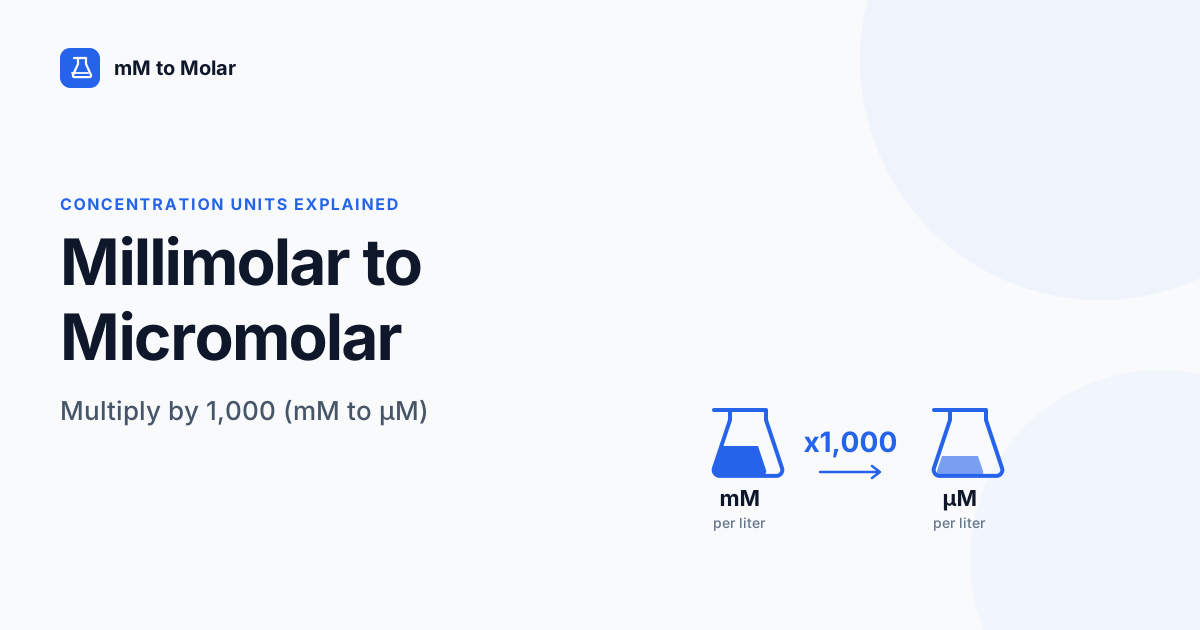
To convert millimolar to micromolar, multiply by 1,000. One millimolar (mM) equals 1,000 micromolar (µM), so 2.5 mM is 2,500 µM. To go the other way, divide by 1,000. That is the whole conversion, and the rest of this guide shows how it works and where people slip up.
If you just need a number, use the micromolar converter and skip the reading.
The formula for mM to µM
Both units measure concentration, which is the amount of a substance in one liter of solution. The prefix tells you the scale:
- Millimolar (mM) = 10 to the power -3 moles per liter
- Micromolar (µM) = 10 to the power -6 moles per liter
Millimolar is 1,000 times bigger than micromolar, so:
µM = mM x 1,000
mM = µM divided by 1,000
Millimolar to micromolar examples
Example 1: Convert 2.5 mM to µM. 2.5 x 1,000 = 2,500 µM
Example 2: Convert 0.05 mM to µM. 0.05 x 1,000 = 50 µM
Example 3: Convert 400 µM to mM. 400 divided by 1,000 = 0.4 mM
A quick check: when you go from mM to µM, the number gets bigger, because µM is the smaller unit. If your answer got smaller, you divided when you should have multiplied.
mM to µM conversion chart
| Millimolar (mM) | Micromolar (µM) |
|---|---|
| 0.001 mM | 1 µM |
| 0.01 mM | 10 µM |
| 0.1 mM | 100 µM |
| 0.5 mM | 500 µM |
| 1 mM | 1,000 µM |
| 5 mM | 5,000 µM |
| 10 mM | 10,000 µM |
| 100 mM | 100,000 µM |
Micromolar to molar
Sometimes you need to skip millimolar and go straight from micromolar to molar. A micromolar is one millionth of a molar, so you divide by 1,000,000:
M = µM divided by 1,000,000
For example, 100 µM = 100 divided by 1,000,000 = 0.0001 M. To reverse it, multiply by 1,000,000. So 0.002 M is 2,000 µM.
The three units line up like this:
| Molar (M) | Millimolar (mM) | Micromolar (µM) |
|---|---|---|
| 1 M | 1,000 mM | 1,000,000 µM |
| 0.001 M | 1 mM | 1,000 µM |
| 0.000001 M | 0.001 mM | 1 µM |
If your starting point is millimolar and you need molar, the mM to molar converter does it in one step.
A real lab example: diluting a stock solution
You have a 10 mM stock of an inhibitor and need 1 mL of a 50 µM working solution. Convert first, then dilute.
- Convert the stock to micromolar: 10 mM x 1,000 = 10,000 µM.
- Use C1V1 = C2V2: 10,000 µM x V1 = 50 µM x 1,000 µL.
- V1 = 50,000 divided by 10,000 = 5 µL of stock.
Add 5 µL of stock to 995 µL of buffer and you have 1 mL at 50 µM. Getting both concentrations into the same unit before you calculate is the step that prevents most dilution mistakes.
Common mistakes
Moving the decimal the wrong way. Millimolar to micromolar is multiplication. If 0.5 mM turned into 0.0005 on your page, you went the wrong direction.
Mixing up µM and mM in a dilution. A 1,000 fold error is easy to make when a stock is written in mM and a target in µM. Convert one of them before you start.
Confusing micromolar with micromole. Micromolar (µM) is a concentration. A micromole (µmol) is an amount. They are related but not interchangeable. This is covered in detail in millimolar vs millimole.
Typing uM. Many people type "uM" because the µ key is hard to find. It means the same thing as µM.
Frequently asked questions
How many micromolar are in a millimolar?
There are 1,000 micromolar in 1 millimolar. So 1 mM = 1,000 µM.
How do you convert micromolar to millimolar?
Divide the micromolar value by 1,000. For example, 250 µM = 0.25 mM.
How do you convert millimolar to micromolar?
Multiply the millimolar value by 1,000. For example, 0.5 mM = 500 µM.
How do you convert micromolar to molar?
Divide by 1,000,000. For example, 75 µM = 0.000075 M.
Is micromolar bigger or smaller than millimolar?
Micromolar is smaller. A solution at 1 µM is 1,000 times more dilute than one at 1 mM.
What does uM mean?
uM is a plain keyboard version of µM, micromolar. They mean the same thing.
Need to convert a value now? Use the micromolar converter for µM, mM, M and nM, or learn what the unit means in what is millimolar.
Written by
Shaheer Akram
Specialist at mM to Molar, developing accurate, peer-reviewed calculation tools and reference guides for chemists, biologists, and laboratory researchers.